managing your time with chronic health conditions
I was recently reminded of a conversation I had years about being honest with what you are capable of when living with chronic illness. It was an eye opening conversation and exercise where we pulled out a yellow legal pad, wrote down everything our health requires on a day to day basis along with all other necessities (like bathing, eating, etc), and evaluated what was left over. This exercise was done with someone who was trying to see what kind of job they could take on after being out of work for a few years due to health issues.
As a Certified Rehabilitation Counselor, I know this is a valid exercise that is extremely helpful to be realistic with what is possible with the time you have in a day. The saying “everyone has 24 hours in a day” does not take into account the people who have to dedicate a large chunk of their day to maintaining their health.
The individual that I did this with realized they only have about 3-4 hours left per day after health appointments, exercises, rest, eating, sleeping, and personal hygiene. This exercise showed that a full-time job was off the table with where their health was at the time. For many individuals, that “free time” won’t grow or change much and that is a hard reality to accept. Especially when chronic illness came later in life and took away what once was. Whichever position you are in, I highly recommend doing this exercise to see your day laid out on paper.
Now, there is a time and place for this type of exercise. If you think you’ll need emotional support for this activity, please find a trusted friend, caregiver, or family member to walk through this journey with you. If you are in the midst of big health changes or struggles, please wait to do this until you are in a maintaining mindset. I want this activity to be beneficial not detrimental to your health journey.
Time management exercise
You will need lined paper, a pen or pencil, and a calculator.
Step 1: Set your intention & mindset
We want to make sure we have an intention behind doing this time management exercise. Are you wanting to start a new job? Start volunteering for a local nonprofit? Find more time to dedicate to your favorite hobby? Be realistic with how much time you spend managing your chronic illness everyday? Whatever it is, write your intention at the top of the page.
A part of this intention setting is also making sure you are in the right mindset. We are not going to do anything if it will only make us feel worse, more stuck in our illness, or be detrimental to our mental health. We want to be in a place where we can be honest, accepting, and reflective with the results we end up with. Save this page in your web browser for another day if needed.
Step 2: List your everyday tasks and habits
To begin, create a list of everything you must do on a typical day. Think of things that you do everyday, not day specific things (we will do this later). Write each item on the left side of your page and then the average time it takes to complete towards the right side. You can make columns on your page if that helps your brain separate the time from the task. This may take some time, so don’t rush it. Make sure to include travel time to and from activities as well. No task is too small! We want to track EVERYTHING.
Example:
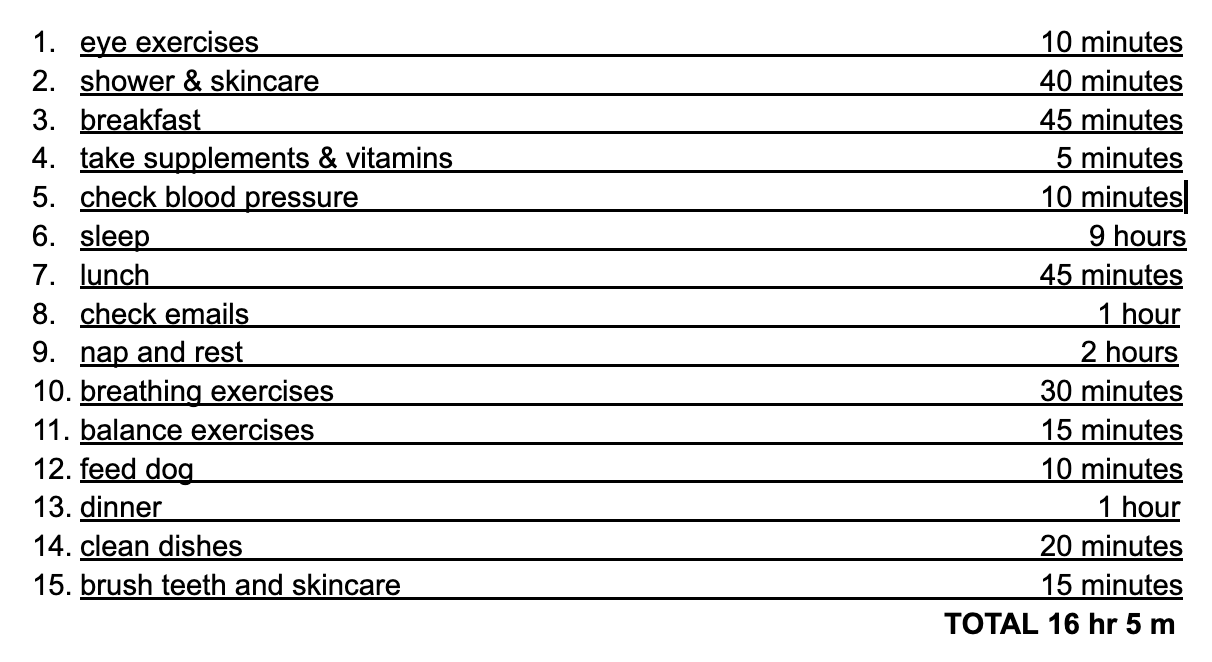
*You can round up to the nearest 5 or 10 minutes for simplicity's sake.
Once you have completed your list of things you do every day, total them all at the bottom of the page.
Step 3: List your day specific tasks and habits
On the next page, you are going to create 7 small columns on the right side of your page. Leaving enough room on the left side to write tasks and make the column big enough to put the time in there. We are going to determine how much weekly time specific tasks take. Do not include anything you are wanting to add in just yet. We will do that later. For now, this is just what you are doing currently on each day of the week.
Example:
*only need to do vertical lines as the page already has horizontal lines
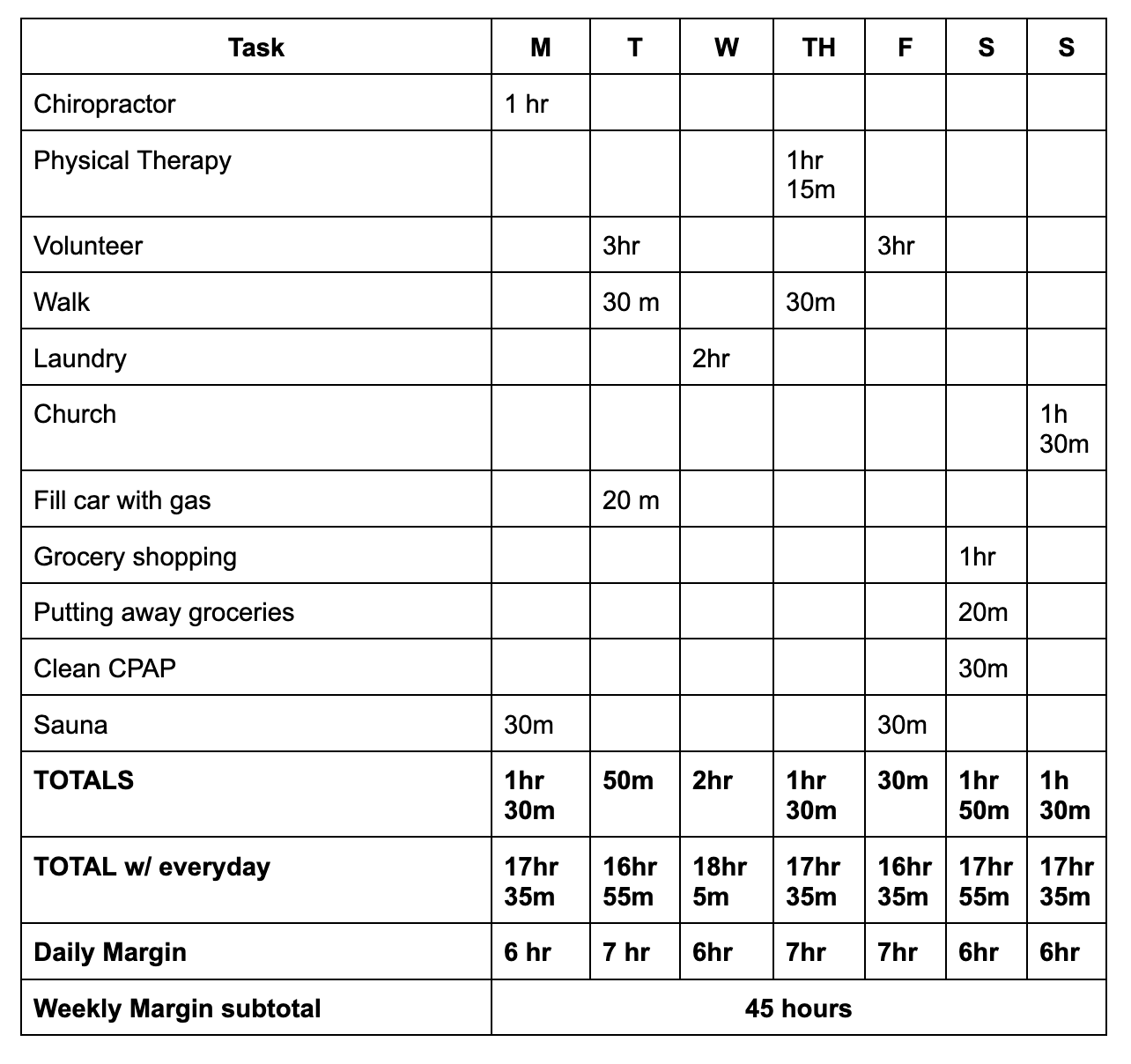
Again, take your time and take breaks if you need. Once you are done with listing all of your day specific tasks, total each day separate from each other. Then, add your everyday total to each day’s total. Finally, subtract that total from 24 to find your daily margin (how much time you have available). *Please feel free to round to the hour at this point.
Step 4: Monthly and irregular tasks
Now we are going to look for those irregular or nonweekly tasks we have in our calendar. List them all out as we did with the everyday tasks list in step 1. This should include doctor’s appointments, coffee dates, social events, etc. We are looking for an average number, not an exact number since these are not always the same every month.
Example:
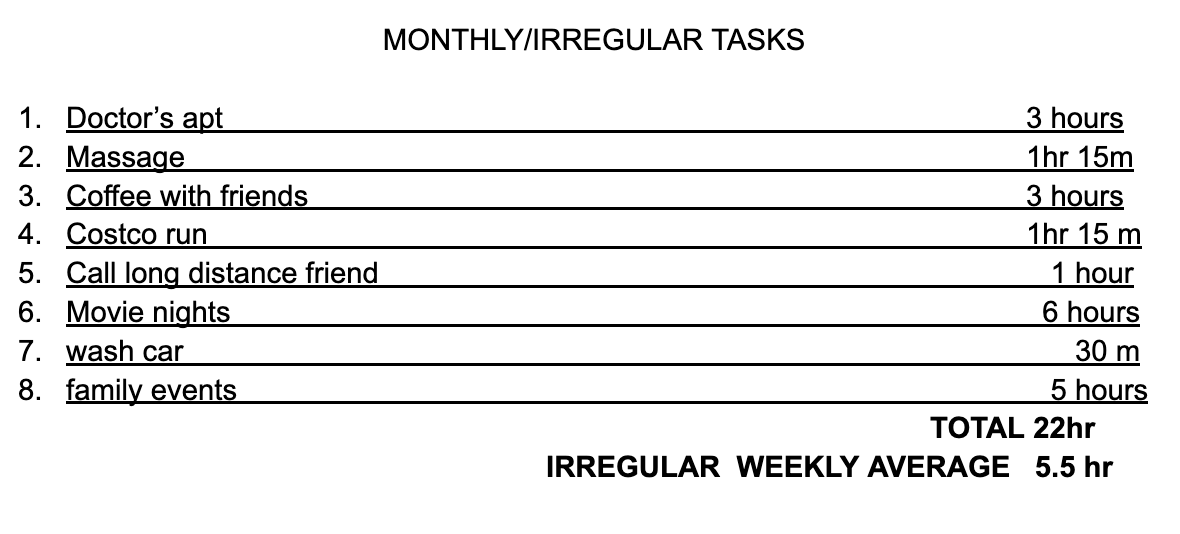
After you complete this, add them all together for a monthly total. Then, divide that number by 4 for an average weekly amount of time that goes towards your weekly.
Step 5: Finding your true margin
Now you have all the numbers you need to find your true margin. This is the last step with math, hang in there with me!
Example:
Weekly margin subtotal (end of step 3) - irregular weekly average (end of step 4) = true margin
45 - 5.5 = 39.5 hours
Step 6: Evaluate your results
Is the end number what you expected? Is it hard to swallow or accept? Take a breather, talk to a friend, walk away from this exercise for a minute if you need to. The number you ended up with may be more or less than you expected. Maybe you were spot on (I’m impressed!). Whatever your outcome, this number is the reality of how much margin (free time) you have in your average week.
Now we are going to go back to the intention and goal we created in step 1. I want you to ask yourself these questions and write down your answers.
Take a minute to acknowledge the hard work you put into your life. Look at all that you do! Write down the things you most enjoy in your schedule.
Do you have enough margin to add what you want or need to do? If not, is there anything you could remove without it lowering your quality of life?
Before you jump into saying yes to adding something to your schedule, your number shouldn’t be zero by the end of this exercise. We need margin in our lives for extra rest, unexpected things that pop up, or for those 3 times we hit snooze in the morning we didn’t want to admit to earlier. What does having margin in your life look like for you? What do you want to be able to slow down and enjoy more in your schedule?
How did this exercise make you feel? Hopeful, sad, or maybe unsure? Write down your thoughts and feelings about the results and the process of this exercise.
The outcome of this exercise may not have been what you expected or wanted. I am so proud of you for being honest and taking the time to see your time management with your chronic illness. You can always update this later when life changes (as it often does) to see what may have opened up. Or the opposite may be true, and that’s okay! You are doing so much already.
I hope this exercise was beneficial for understanding how much time and effort you truly put into managing your chronic illness. Remember, your body is what carries you through your day. You are worth the time you have to put in to maintain your health!
teresa margaret